A warehouse run, end to end
The office survey in Running the survey demo is the smallest thing the bridge can drive. This is a larger one: two robots in an AWS warehouse, a pallet that may be in either of two bays, and a policy that inspects before it commits.
It is worth reading because every field of the task map that the survey leaves at its default is exercised here, and because the run shows what the epistemic state is actually doing while Open-RMF moves the robot.
warehouse_rmf_demo lives in the
Epistemic-Robotics
repository, under ros2_ws/src, alongside a hotel scenario built the same
way. Only the bridge it launches is documented here.
The floor
Open-RMF drives robots over a nav graph, and the domain names zones. The two vocabularies have to agree, so the graph is generated from the same source the domain is written against and checked against the occupancy grid.
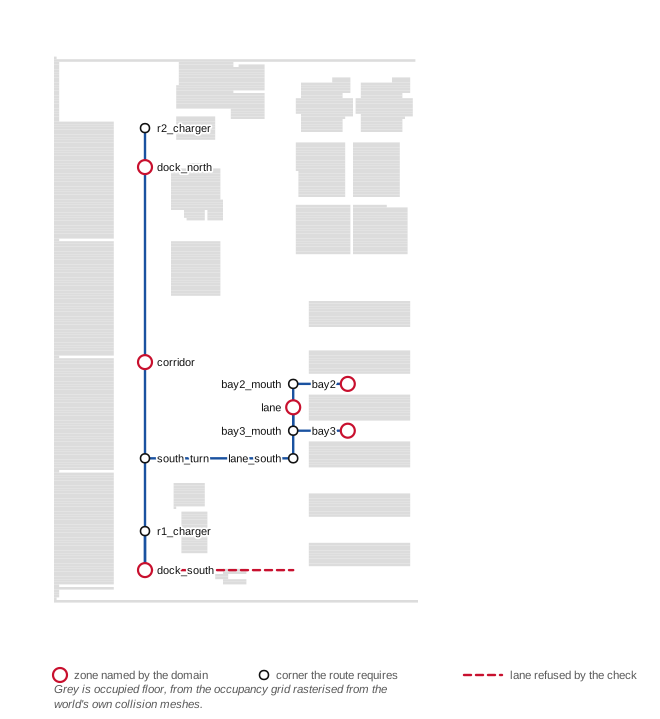
Fig. 12 The nav graph over the occupancy grid, with one lane refused by the check
Not every vertex is a zone. dock_south, corridor, dock_north,
lane, bay2 and bay3 are named by the domain; bay2_mouth,
south_turn and the chargers exist because a route needs a corner to turn at.
A lane that crosses occupied floor is refused rather than drawn, which is the
check that keeps the graph and the world in agreement.
The map
The survey’s map fixes a waypoint per action. This one takes the destination from the action’s own arguments, which is what lets a handful of entries cover a domain that names zones in its actions:
{
  "zones": {
    "dock_south": "dock_south", "corridor": "corridor",
    "dock_north": "dock_north", "lane": "lane",
    "bay2": "bay2", "bay3": "bay3"
  },
  "agents": {
    "r1": {"fleet": "warehouseBot", "robot": "r1"},
    "r2": {"fleet": "warehouseBot", "robot": "r2"}
  },
  "actions": {
    "goto_zone": {"waypoint_arg": 2},
    "look_into": {
      "waypoint_arg": 1,
      "sensing": true,
      "outcome_arg": 1,
      "outcomes": {"bay2": "e-inspect-found", "bay3": "e-inspect-empty"},
      "default_outcome": "e-inspect-empty"
    },
    "pick_up":  {"waypoint_arg": 1},
    "drop_off": {"waypoint_arg": 1},
    "announce": {"local": true, "duration": 4.0}
  }
}
goto_zone reads its destination from argument 2, so
(goto_zone r1 lane bay2) sends r1 to bay2 without the map naming
either. look_into is the sensing action, and its outcomes table is the
simulator’s ground truth: inspecting bay2 finds the pallet and inspecting
bay3 does not. A fleet whose adapter reports a real observation overrides
all of it, and default_outcome is what the bridge falls back to with a
warning when nothing reports.
The zones table is an identity here, since the graph generator already used
the domain’s names. It is written out anyway: the two vocabularies agreeing is
a fact worth stating rather than an accident to rely on.
The bridge is launched as an ordinary node, with the map and the port the fleet adapter is pointed at:
Node(package='eplansys_rmf_bridge',
     executable='rmf_action_node',
     parameters=[{'task_map': map_file.name,
                  'websocket_port': WEBSOCKET_PORT,
                  'task_timeout': 900.0}])
A 900 second timeout rather than the default 120: a warehouse traverse under RMF’s traffic management takes as long as it takes.
The policy
The planner does not know which bay holds the pallet, so it cannot produce a sequence. It produces a policy with a branch at the one action that finds out.
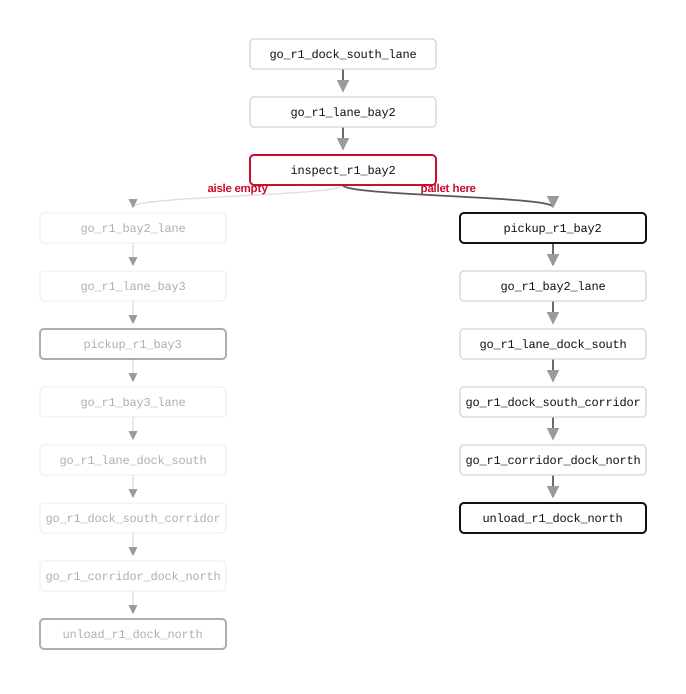
Fig. 13 One sensing action, two branches, both ending at the north dock
Everything above inspect_r1_bay2 is common. Below it the two arms differ
only in where the pallet is picked up, and both finish by unloading at
dock_north. The token the bridge lifts out of the RMF task state is what
selects the arm: e-inspect-found takes the right, e-inspect-empty sends
the robot on to bay3.
What the model does while the robot drives
The epistemic state applies a product update after every action, whether or not that action told it anything new. Most actions do not.
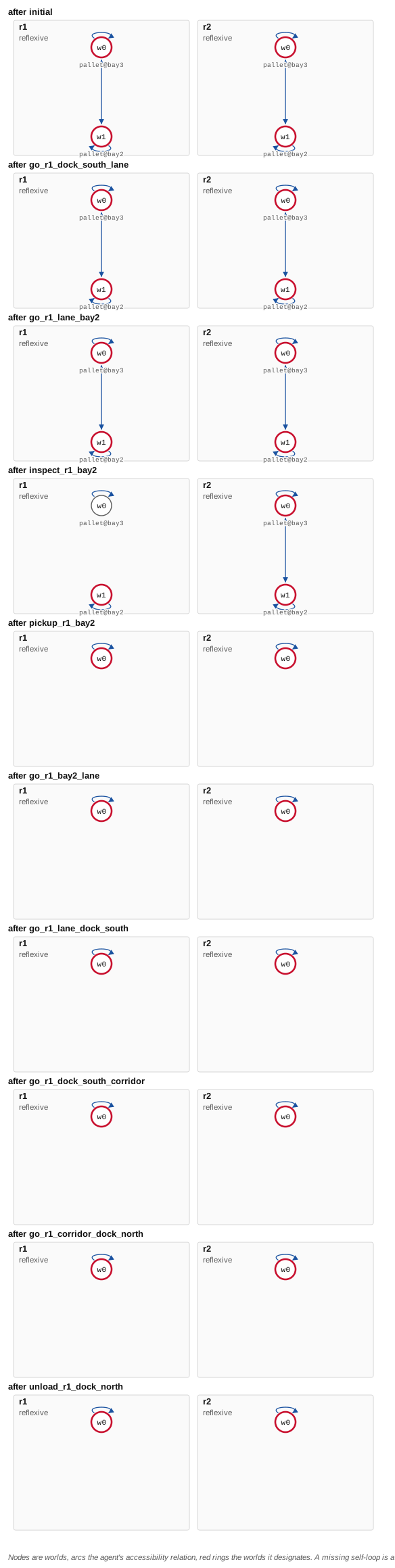
Fig. 14 The model after each action, for both robots
Two worlds survive every go action: driving somewhere tells nobody where the
pallet is. The collapse happens at inspect_r1_bay2 and nowhere else, and it
is asymmetric, since r1 looks and r2 does not. That asymmetry is the
thing a classical planner has no way to represent, and it is why the outcome has
to travel back from the fleet rather than being assumed.

Fig. 15 The accessibility relation at each step
The table is the same run counted rather than drawn. |R| is the size of the
agent’s accessibility relation and the classes column is how many distinct sets
of worlds it still considers possible. A frame that stops being reflexive has
left S5, and the agent holds belief rather than knowledge from that point on,
which is a thing to notice rather than a thing to allow by accident.
The trajectory

Fig. 16 What the robot actually drove
RMF moved the robot; the policy only said where to go next. Traffic management, the lanes and the door and lift negotiation are all Open-RMF’s, and the bridge forgoes none of it. What it takes back is the allocation, so that the agent the model credits with knowing is the robot that actually looked.